
If a company promises to erase bad credit, boost your score overnight, or charge you before doing any work, start with the law that was written for exactly that problem: the Credit Repair Organizations Act, usually shortened to CROA.
CROA is a federal consumer-protection statute aimed at companies that sell credit repair services for money. It requires specific disclosures, a written contract, a three-business-day cancellation right, and a strict ban on charging before the promised service is fully performed. It also gives consumers the right to sue when a company lies, hides the true cost, or takes money too early.
This guide focuses on the questions people actually search for: What is CROA? Can a credit repair company charge upfront fees? What has to be in the contract? And what can you recover if the company crossed the line?
What Is the Credit Repair Organizations Act?
CROA is a federal law codified at 15 U.S.C. Sections 1679 through 1679j. In practical terms, it applies to businesses that take money to improve a consumer's credit record, credit history, or credit rating, or that sell advice or assistance for that purpose.
The law exists because consumers in financial trouble are easy targets. A company can take a real problem - a low score, a denied mortgage, a collections account - and sell false certainty. CROA was designed to force those companies to put the terms in writing, stop misleading consumers, and stop taking money before they finish the work they promised to do.
If you are dealing with a company that told you it could remove accurate negative information, create a new credit identity, or guarantee a score jump for a fee, compare its conduct against the rules below. If the problem looks broader than a bad contract and you want to evaluate a claim, review our credit repair scams practice page next.
Who CROA Usually Covers - and What It Does Not
The statute is aimed at credit repair organizations that sell credit-improvement services for money. It does not cover every company that talks about debt or credit. The statute's definition excludes certain nonprofits, creditors helping with debt owed to themselves, and depository institutions and credit unions in the circumstances listed by the statute.
That distinction matters because some companies try to sound like they are outside the law when they are not. Calling a program advisory, coaching, or file optimization does not automatically take it outside CROA if the real service being sold is credit repair for money. The same issue can come up when debt collectors promising credit repair use deletion or score-improvement claims to pressure payment.
It also matters because CROA is not the only relevant law. A consumer may also have claims under the Fair Credit Reporting Act dispute process, state unfair-trade-practices laws, or fraud theories depending on what the company promised and what it actually did.
The Core CROA Rules Consumers Should Know
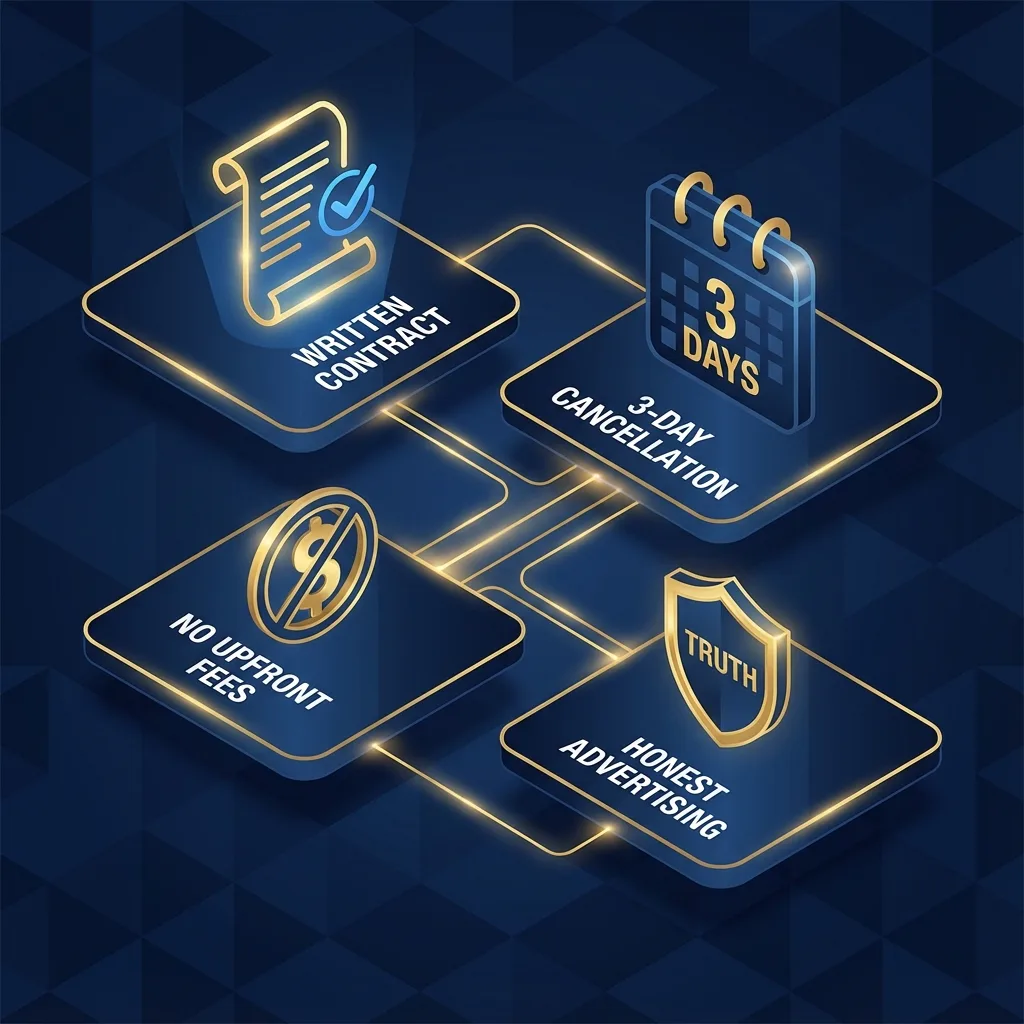
1. No upfront fees
This is the rule that shows up most often in real-world scams. CROA says a credit repair organization cannot charge or receive money for a service before that service is fully performed. If the company took an enrollment fee, setup fee, monthly fee, or a first work fee before finishing the promised service, that is a major warning sign.
That is why many search queries around CROA focus on upfront fees. They should. The law is explicit here, and it is one of the cleanest places to start a factual review.
2. Required written disclosures before the contract
Before the contract is signed, the company must give the consumer a written statement of credit-file rights. Among other things, that disclosure explains that accurate and current negative information cannot simply be removed because a company says so. If a business skipped this step or buried it in marketing copy, that matters.
3. A written and dated contract is required
CROA also requires a written contract before services are provided, and the contract must include specific terms. That means consumers should be able to see, in writing, what services the company claims it will perform, what the total cost is, how long the work is expected to take, and who exactly is selling the service.
If the company relied on vague promises like premium dispute sequencing, secret bureau relationships, or custom legal deletions without clearly describing what it was actually going to do, that is not the kind of transparent contract CROA was designed to permit.
4. A three-business-day cancellation right
CROA gives consumers the right to cancel the contract without penalty or obligation before midnight of the third business day after signing. The company must provide a cancellation form and tell the consumer how to use it. If the seller discouraged cancellation, hid the deadline, or refused to honor a timely cancellation, that is not a minor customer-service issue. It can be part of the CROA problem itself.
5. No deceptive claims about what the company can do
CROA prohibits untrue or misleading statements about the service. That includes claiming the company can legally remove accurate current negative information, telling consumers to use a new identity, or making guarantees that are not grounded in reality. The FTC has repeatedly warned consumers that no credit repair company can legally make accurate negative information disappear just because the consumer paid for help.
What Must Be in a CROA Contract?
At a minimum, the contract should identify the company, explain the services in detail, and spell out the total amount the consumer is expected to pay. It should also describe how long the services are expected to take and include any guarantees the company is making.
That sounds basic, but the older CROA cases and FTC enforcement materials show the same pattern over and over: a vague pitch up front, then a contract that does not really say what the company will do, or a contract that is inconsistent with the sales call. If the paperwork does not match the promise, save both.
If you are trying to separate legitimate help from a scam, our guide to recognizing and avoiding credit repair scams is the best companion read after this one.
Can a Credit Repair Company Remove Accurate Negative Information?
No. That is one of the most important consumer takeaways. Accurate and current negative information generally stays unless the law says it has aged off or the furnisher or bureau corrects it because it was wrong in the first place. A company can help you dispute inaccurate information, organize records, or explain rights, but it cannot legally erase accurate negative history on command.
That is also why many CROA scams overlap with credit-reporting disputes. A company takes money, sends form letters, and acts as if it can force permanent deletions even where the underlying information is accurate. If your problem is actually an inaccurate tradeline, identity-theft account, or mixed file, the better legal path may be an FCRA dispute strategy rather than paying a credit repair seller. Start with our article on removing fraudulent accounts from your credit report if fraud is involved.
What Can You Recover in a CROA Lawsuit?
CROA gives consumers a private right of action. In an individual case, the statute allows recovery of the greater of actual damages or the amount the consumer paid to the credit repair organization, plus whatever punitive damages the court allows and, in a successful action, costs and reasonable attorney's fees.
That matters because a consumer does not need a giant-dollar loss to have a meaningful claim. If the business took money it was not allowed to take, hid required disclosures, or made deceptive promises, the payment history itself may be part of the damages picture.
Credit Repair Claim Review
If a credit repair company charged you before completing the promised work, hid the real terms, or sold you a fake solution, review our credit repair scam lawyer page to see how those claims are evaluated.
What To Do If You Think a Company Broke CROA
Save the contract, the cancellation notice, and the sales pitch. Do not keep only the final invoice. Save text messages, emails, the intake form, and any claim that the company guaranteed deletions or score increases.
Build a payment timeline. Note every amount you paid, the date of each payment, and what the company claimed it had already completed at that point. If the company was still working the file after taking money, that timeline matters.
Pull your current reports and compare them against the promise. If the company said it removed accurate negative information, ask yourself what actually changed and whether the change was temporary. The FTC's guidance is blunt here: no one can legally remove accurate and current negative information from a credit report.
Do not rely on a verbal refund promise. If the company says it will make it right, get the details in writing. Many bad actors stretch out the complaint process until the consumer stops pushing.
Check whether the real issue is a bureau or furnisher error. If the problem is inaccurate reporting, the right fix may be a dispute with the bureau or furnisher rather than more money paid to a credit repair seller.
The Real Bottom Line on CROA
CROA is most useful when you stop treating the situation like a customer-service problem and start treating it like a legal framework. The key questions are concrete: Did the company charge before it completed the work? Did it make claims it could not legally deliver? Did it give the required disclosures and contract terms? Did it honor the cancellation right?
Those are the questions that separate a disappointing service from a potentially actionable violation. If the answer to several of them is no, the issue is no longer just whether the company helped your credit. The issue is whether it took your money in a way federal law prohibits. For a broader plain-English overview of the same rights, see our guide to CROA consumer rights.
This article is for educational purposes only and does not create an attorney-client relationship. Credit repair, consumer reporting, and state-law claims can overlap, and the right path depends on the facts and the documents. Last updated: April 2026.