
You went to the emergency room. Maybe you drove yourself. Maybe someone called an ambulance for you. Maybe you were unconscious when they wheeled you in. Nobody sat you down and explained what the treatment would cost. Nobody asked whether you could afford it. Nobody got your informed financial consent before the IV went in.
Months later, a debt collector calls about a bill for $8,000. You are stunned. And your first reaction is reasonable: I never agreed to this.
The frustrating legal reality is that emergency care does not require your financial consent. But the frustrating legal reality also includes this: the debt collector who calls about that bill still has to follow the FDCPA debt collection rules.

In This Guide
Why Hospitals Can Bill Without Consent
The Emergency Medical Treatment and Labor Act (EMTALA) requires hospitals with emergency departments to provide medical screening and stabilizing treatment to anyone who arrives, regardless of insurance status or ability to pay. EMTALA exists to prevent hospitals from turning away patients in crisis. It is a critical protection.
The flip side is that the right to receive emergency care is not the same as the right to receive emergency care for free. After the emergency is resolved, the hospital can and will bill for the services provided. That bill can become a medical debt collection problem if it goes unpaid. And the collector can pursue it under the law.
What the collector cannot do is pursue it outside the law.
Where the Violations Emerge
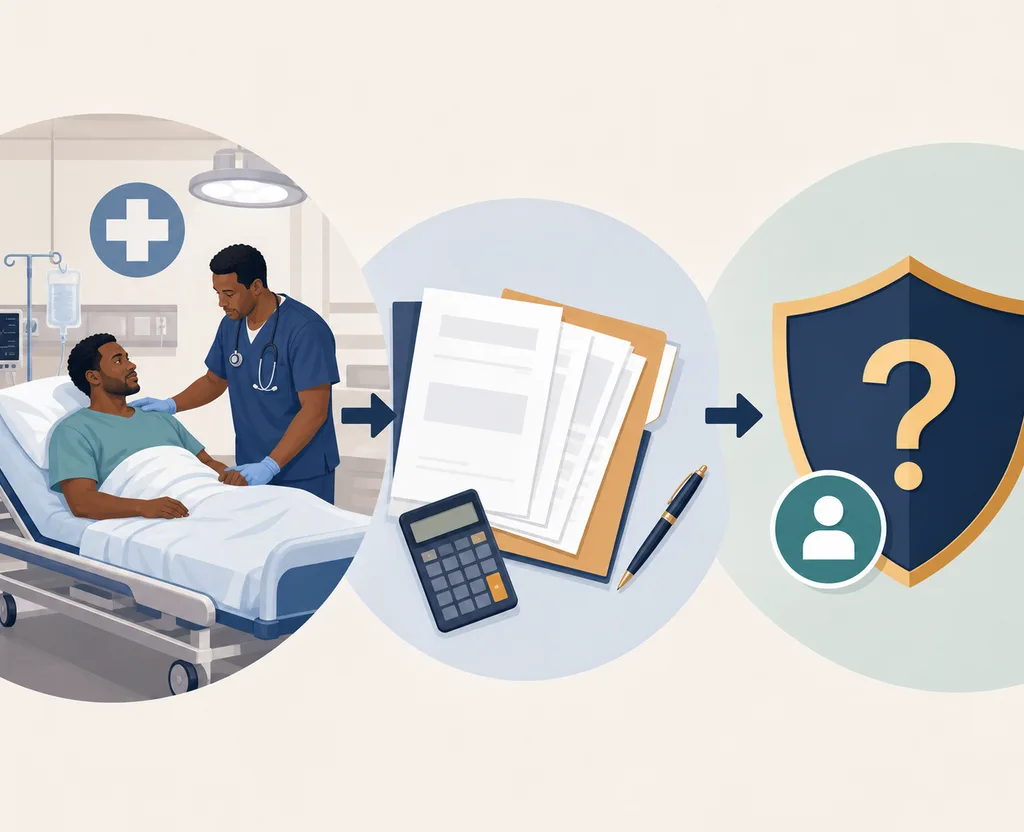
Emergency room billing is famously unreliable. Bills generated in emergency settings are created under chaos -- rapid coding, multiple providers, overlapping services, and minimal patient interaction. The result is that ER bills contain errors at a higher rate than almost any other category of medical billing.
When those errors get passed to a debt collector, every inaccuracy becomes potential FDCPA exposure. The collector demands a balance that includes charges for services never received -- that misrepresents the amount under § 1692e. The collector adds collection fees not authorized by the original hospital agreement -- that violates § 1692f(1). The collector claims the full billed amount when insurance should have reduced the patient's responsibility -- that is a false representation of the debt.
The No Surprises Act Protection
The No Surprises Act (effective January 1, 2022) added an important layer of protection for emergency patients. Under the Act, patients cannot be balance-billed at out-of-network rates for emergency services. If you had insurance and received emergency care, your cost-sharing (copay, coinsurance, deductible) should be calculated at in-network rates, even if the treating providers were out-of-network.
If a collector is pursuing the full out-of-network balance on an emergency visit that should have been protected by the No Surprises Act, the amount they are collecting may exceed what you legally owe. That puts the collector in the position of collecting an inflated debt -- which creates FDCPA exposure.
Illinois Hospital Billing Obligations
Under Illinois law, hospital bills must explain what is being charged and how to request more detail. For uninsured patients, the bill must include information about financial assistance programs. Hospitals must screen uninsured patients for financial assistance before starting collection efforts.
If the hospital sent your ER bill to collections without following these requirements, the collection effort may be procedurally flawed. And if you were uninsured and the hospital never informed you of available assistance programs, you may have been denied rights under state law before the collector ever made its first call.
Request an Itemized Bill
The single most important step you can take when facing an ER collection is to request an itemized bill from the hospital. Compare it line by line against your insurance EOB if you had coverage. Look for duplicate charges. Look for charges that do not match the treatment you received. Look for billing codes that seem inflated.
Medical billing errors are not theoretical. Studies have consistently found that a significant percentage of hospital bills contain errors. In emergency settings, where documentation is rushed and coding happens after the fact, the error rate is even higher.
If the account also appears on your credit report, review our medical debt credit reporting rules guide before assuming the collector's number is accurate.
If the collector's amount does not match the accurate total, dispute the debt in writing under 15 U.S.C. § 1692g. For instructions, see our debt validation letter under FDCPA §1692g.
It Costs You Nothing
You did not ask for the ER bill. But the FDCPA gives you tools to fight a collector who handles it improperly. Under 15 U.S.C. § 1692k, the collector pays your attorney's fees if your case is successful. No upfront cost. No out-of-pocket expense. That is how consumer protection law works.
If a collector is pursuing an ER bill that is wrong, inflated, or being collected through unlawful means, Hyslip Legal can review the collection conduct and the billing paper trail. The consultation is free and so is the representation.
Related Reading
- A Medical Bill Went to Collections Without Warning. Now What?
- Debt Collector Calling About a Medical Bill Insurance Was Supposed to Pay
- Can a Hospital Send Me to Collections While I'm on a Payment Plan?
- Medical Debt on Your Credit Report: What Changed, What Didn't, and What You Can Do About It
- Can Medical Debt Collectors Garnish My Wages in Illinois?
- Medical Debt After a Loved One Dies: Can Collectors Come After the Family?
This information is for educational purposes only and does not create an attorney-client relationship with Hyslip Legal, LLC. Legal outcomes depend on the facts of each case.